SENUMAC
optimisation of bulk
cargo handling
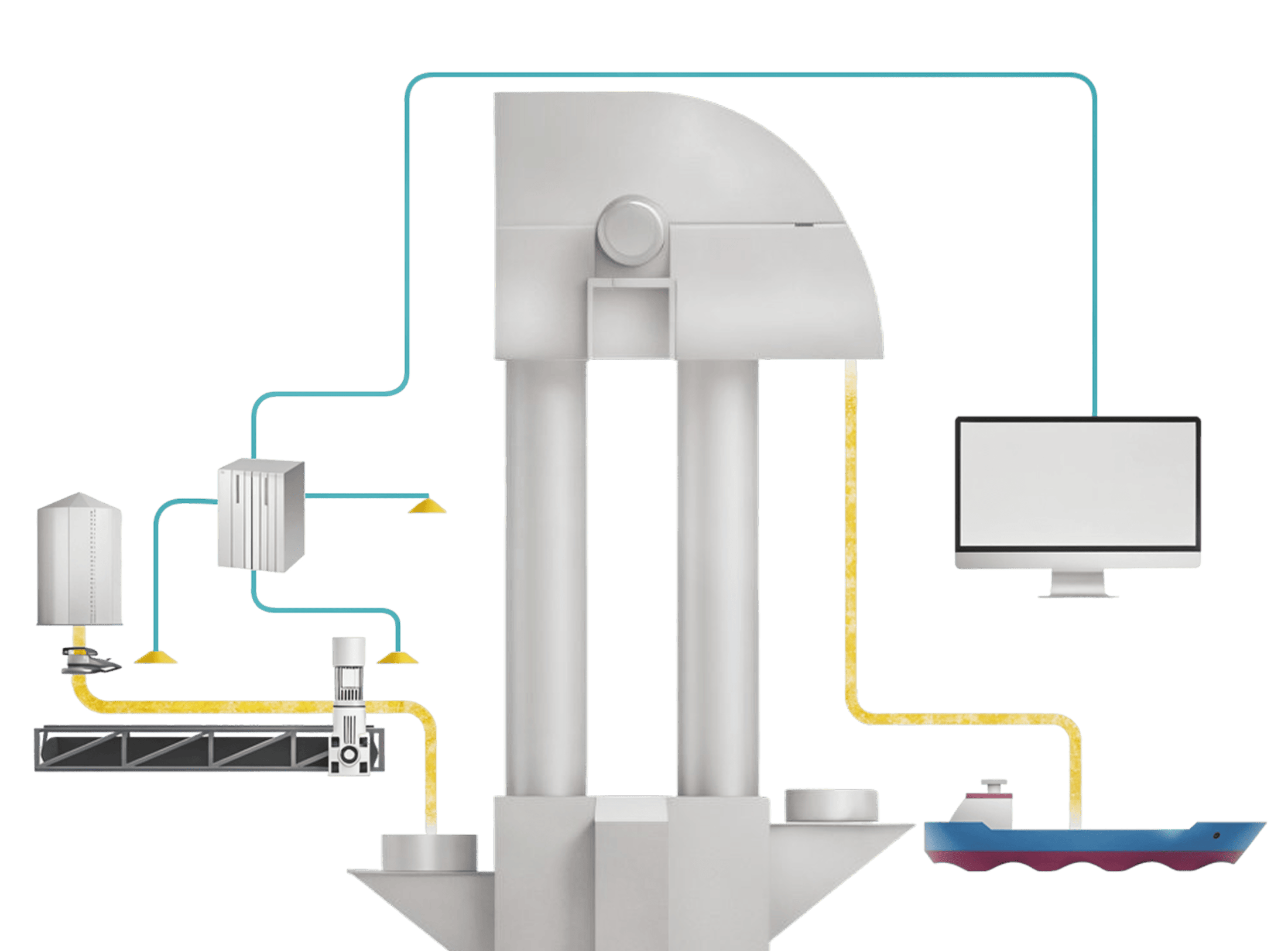
SENUMAC is an advanced automation technology for controlling bulk material conveyor loading at grain terminals, elevators and ports. SENUMAC Technology optimises throughput by automatically maintaining stable operating conditions, reducing manual intervention, improving energy efficiency and increasing overall performance in terminal operations.
Thanks to intelligent control algorithms, the system ensures predictable equipment operation, reduces downtime, minimises wear and tear on machinery, and enables more efficient use of the terminal’s infrastructure.

What is SENUMAC?
SENUMAC is a patented, modern, comprehensive control system for conveyor loading, featuring innovative technologies for optimisation and guaranteed management. The technology addresses several core challenges faced by grain elevators and transshipment terminals: it increases loading productivity, minimises human influence and reduces energy consumption.
SENUMAC minimises human involvement by automatically bringing the system to its optimal operating mode and maintaining it in real time. This allows terminals to reduce vessel, railcar and truck loading times, increase overall throughput and lower operational costs.
Through precise load regulation, SENUMAC reduces energy consumption, decreases mechanical equipment wear and improves the quality of grain handling. The technology is already implemented at large grain terminals and has proven its effectiveness in real port operating conditions, where reliability, energy efficiency and predictable performance are critical.
Before developing our system and starting its implementation, our specialists thoroughly studied all the problems of port infrastructure that terminal owners face. When implementing pilot projects at the largest port terminals in Ukraine, we strictly structured them and proposed a system that solves virtually all internal and operational issues.
Why is it necessary SENUMAC, SENUVOL and Digital Twin?
SENUMAC is a highly efficient automated conveyor line control system designed to optimise the process of shipping and transhipment of grain and other bulk cargoes at elevators and port terminals.
SENUVOL is an innovative technological system for high-precision measurement of the level, profile and volume of bulk cargo in containers in real time, allowing effective control of storage and accounting volumes of materials such as grain, which is a key element in optimising logistics and production processes.
DIGITAL TWIN is a virtual copy of the terminal that works with Senumac and Senuvol data in real time. It simulates operational scenarios (ETA, peaks, breakdowns), identifying risks and opportunities in advance, which is critical for business planning.

The Role of SENUMAC in Energy Consuption
Modern ports and grain terminals operate under constant pressure: seasonal export peaks, unpredictable vessel arrivals, limited berthing windows, rising electricity tariffs, and infrastructure wear and tear. Traditional planning tools often lack real-time visibility and operational flexibility, which leads to warehouse congestion, low line utilisation, and frequent manual switching becoming a systemic issue.
All these factors create a chain of losses:
unstable schedules → equipment downtime → excessive energy consumption → vessel demurrage → direct financial losses.
Demurrage is not the root cause—it is the final and most expensive symptom of a broader spectrum of operational problems that directly impact margins and business predictability.
SENUMAC breaks this chain of losses through comprehensive automatic control of conveyor loading and line operation logic
The system provides:
- Real-time synchronisation of equipment operations;
- Optimised conveyor loading without overloads or “empty runs”
- Elimination of manual switching and planning errors
- Forecasting and prevention of downtime
- Stabilisation of loading speed regardless of human factors
From an energy efficiency perspective, this delivers several key benefits:
-
Reduction of peak loads — equipment operates in optimal modes without abrupt starts and overloads.
-
Elimination of idle cycles — conveyors and auxiliary systems do not run without productive load.
-
Shorter vessel loading time — fewer operational hours mean lower total energy consumption.
-
Reduced infrastructure wear — fewer emergency stops and energy-intensive restarts.
As a result, SENUMAC Technology transforms energy from an uncontrolled cost factor into a managed operational parameter.
This is not just about reducing demurrage — it is about increasing overall terminal productivity, improving schedule predictability, and delivering systemic electricity savings that directly enhance operating margins.
For ports and grain hubs operating in volatile market conditions, SENUMAC becomes not only an automation tool, but a strategic instrument for operational resilience and sustainable efficiency.

Unique Solution
We offer not just automation of individual processes, but a comprehensive solution to a global operational challenge faced by modern ports — a Real-Time Digital Twin built on our SENUMAC and SENUVOL technologies.
This is a next-generation system that connects core terminal scenarios in real time, eliminates the gap between planning and actual operations, and reduces up to 20% of systemic inefficiencies — returning millions of dollars that are otherwise lost each year due to operational friction.
By combining:
- SENUVOL— high-precision, real-time inventory monitoring inside silos;
- SENUMAC— intelligent optimization of vessel loading and conveyor line control;
- Port Digital Twin — a dynamic digital model of all key operational flows;
we create a unified digital management environment for the terminal.
This approach ensures a continuous stream of reliable operational data — from actual grain volumes in each silo to real-time vessel loading speed and energy consumption of conveyor lines. The system does not merely display data; it synchronizes processes, predicts bottlenecks, and automatically adjusts operational scenarios.

Business Impact
Integration with SAP ERP connects operational execution with financial and managerial control layers. This enables:
- Full alignment between planning and execution.
- Reduced demurrage and downtime.
- Lower energy consumption through optimised operating modes.
- Reduced infrastructure wear and emergency stops.
- Enhanced transparency for management and shareholders.
- Scalability as throughput volumes increase.
Instead of reactive management, the port gains predictive control. Instead of hidden losses, it gains measurable performance. Instead of chaotic peak loads, it achieves stable and forecastable productivity.
This approach transforms the port from a set of fragmented processes into a synchronised, energy-efficient, and scalable node within the global supply chain.
Call us and you will receive comprehensive information about the conditions and benefits of implementation by phone +48 32 33 55 673
Implemented SENUMAC Projects
1. Risoil Marine Grain Terminal (Chornomorsk, Ukraine)
S-Engineering began implementation of the SENUMAC system at the Risoil marine grain terminal, including assembly, software development, and commissioning works. The system is intended to optimize grain loading, increase terminal productivity, reduce energy consumption by up to ~20%, and shorten vessel loading times. Multiple SENUMAC systems are planned to operate in parallel to support loading of different vessels.
2. COFCO International Marine Terminal, Mykolaiv, Ukraine
At the COFCO International (“DSSC”) terminal in Mykolaiv, S-Engineering integrated SENUMAC into the terminal’s automation and control systems. The company also delivered power supply, automation infrastructure, and process control systems. After implementation, the terminal handled approximately 1.5× more grain per year than its design capacity.
3. Posco International Grain Terminal, Mykolaiv, Ukraine.
S-Engineering applied its SENUMAC technology at the Posco International grain terminal (in cooperation with Orexim) in Mykolaiv. This included project documentation, software development, equipment fabrication, and commissioning. The SENUMAC system helped to increase productivity by more than 10%, reduce specific energy consumption, and achieve automated grain mixing and loading efficiency.
4. Bunge Limited – “Greentour-Ex” Terminal, Mykolaiv, Ukraine.
S-Engineering carried out a major automation and electrification project at the Greentour-Ex production and transshipment complex, owned by Bunge Limited (USA), located at berths No. 13 and 14 of the Mykolaiv Sea Port.
5. Terminal Borivazh (Pivdennyi Port, Ukraine) (in progress)
S-Engineering reported feasibility studies and modernization projects for Terminal Borivazh with SENUMAC. According to company updates, potential benefits include reduced energy costs (~17% less) and increased terminal productivity. SENUMAC implementations already cover terminals with a combined ~12 million tons/year design capacity.